

If you’re dealing with the pinching, catching pain of shoulder impingement, you’ve likely tried stretches, rotator cuff exercises, and maybe even traditional, static cupping. While these can offer temporary relief, they often miss the core mechanical problem with shoulder impingement. A chronic compression and a failure of tissues to glide smoothly.
At Redbird Wellness in Hopkins, we use a different approach. Dynamic cupping for shoulder impingement is integrated with targeted expansion exercises. This isn’t passive therapy. It’s an active recalibration of your shoulder’s mechanics. Let’s break down why this method is fundamentally different and how it creates lasting change where other treatments fall short.
Dynamic Cupping for shoulder impingement is a revolutionary technique that combines active rehabilitation with cupping therapy, ensuring a holistic approach to relief.
The Impingement Problem: More Than a Tight Muscle
Impingement is fundamentally a space issue. The tendons of your rotator cuff and the bursa (a fluid-filled sac) are getting pinched under the bony arch of your shoulder blade (the acromion). Traditional thinking blames “tight” muscles and prescribes stretching. But this is an oversimplification.
The real issue is often:
- Poor Tissue Glide: The layers of muscle, tendon, and fascia (connective tissue) in your shoulder and upper back have become stuck together, like layers of tape that won’t slide. This restricts motion and increases compressive forces.
- Stiff Connective Tissue: The fascia itself loses its viscoelastic quality, its natural “give” and bounce. It becomes more like stiff leather than elastic rubber, contributing to stiffness and poor force absorption.
- Dysfunctional Movement Patterns: Your body compensates by using muscles that further depress the shoulder blade or elevate the humerus, perpetuating the crunch.
Static treatments, including traditional “leave the cups” cupping, address none of these causes effectively. They may increase blood flow to a general area but fail to create the specific, mechanical changes needed to resolve impingement.
Why Shoulder Impingement Persists Even When You’re “Doing the Right Exercises”
Many people with shoulder impingement are already diligent with rotator cuff strengthening and mobility drills. The issue isn’t effort, it’s context. Exercises performed on top of restricted, adhered tissue often reinforce faulty mechanics. Without restoring tissue glide first, strengthening can increase compression rather than relieve it. Dynamic cupping for shoulder impingement creates the mechanical conditions that allow exercises to actually do what they’re supposed to do.
Why Dynamic Cupping is a Game-Changer for Impingement
Dynamic (or gliding) cupping is a form of Instrument-Assisted Soft Tissue Mobilization (IASTM) that works through decompression and controlled shear. Here’s how it directly attacks the impingement triad:
- It Separates to Glide: As the cup glides across your skin, it lifts and separates the stuck layers of muscle, tendon, and fascia. This isn’t a superficial massage; it’s a deliberate mechanical intervention to restore the independent sliding ability of these tissues. When your rotator cuff tendons can glide freely under the acromion, impingement diminishes.
- It Remodels for Elasticity: The sustained decompressive force improves the viscoelastic quality of the connective tissue. Think of it as gently persuading stiff leather back toward supple elastic. This gives the tissue more “bounce,” allowing it to absorb force better and move through a fuller range without strain.
- It Prepares for Movement: The sensation should be a strong, pulling tension that is often described as a “good hurt,” but never a sharp, pinching, or nerve-like pain. This controlled discomfort creates a unique therapeutic window that increases blood flow and alters tissue tension while temporarily modulating the nervous system’s pain signals. This allows us to do the most important part of the treatment next.
The Nervous System’s Role in Shoulder Impingement
Dynamic cupping for shoulder impingement doesn’t just affect tissue, it affects perception. Persistent shoulder pain often involves heightened nervous system sensitivity, where the brain interprets movement as threatening even when tissue damage is minimal. The decompressive input from dynamic cupping provides novel sensory information that can reduce protective guarding and recalibrate how the nervous system interprets shoulder movement. This is why many patients notice immediate improvements in range of motion following treatment.
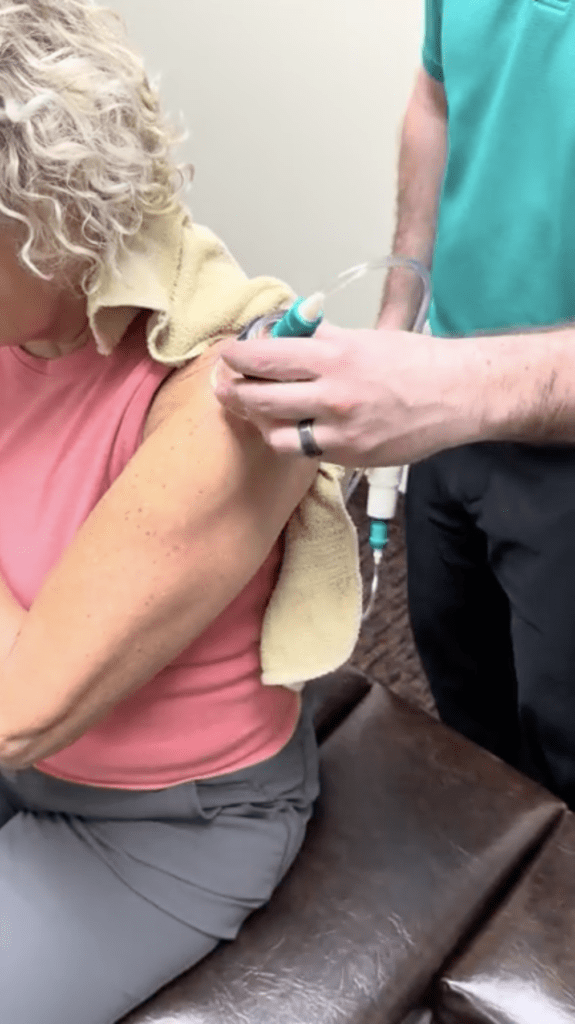
The Critical Integration: Movement Re-Education WITH the Cups On
This is where our Hopkins clinic protocol diverges completely. We don’t end with the cups coming off. We begin the most important work while they are still on.
Immediately after gliding the cups to improve tissue slide, we place cups strategically to maintain decompression in key areas often along the upper back and around the shoulder blade. Then, we guide you through specific, “expansion-based” movements in all three planes of motion. Why expansion? Because impingement is a compression problem. The solution is to create space.
Your integrated movement session will focus on:
- Thoracic Extension: Freeing your mid-back from a slumped, rounded posture.
- Scapular Protraction & Upward Rotation: Teaching your shoulder blade to glide forward and upward on your rib cage, creating physical space under the acromion.
- Shoulder Flexion, Abduction, and External Rotation: Safely reclaiming the ranges of motion you’ve been avoiding, now with the supportive decompression of the cups.
Why Expansion-Based Movement Is Essential for Long-Term Change
Expansion-based movement retrains your body to access space actively, rather than relying on passive positioning or force. By practicing expansion while decompressed, your nervous system learns that overhead and rotational movements are safe again. This is how dynamic cupping for shoulder impingement transitions from symptom relief into true movement retraining.
The magic happens in the integration. We don’t isolate your thoracic spine, then your scapula, then your shoulder. We train them to move together as a coordinated unit. By performing these expansion patterns while the cups maintain tissue separation, you are literally retraining your neuromuscular system in an optimized state. You’re building a new, pain-free movement memory where space, not pinch, is the default.
Static vs. Dynamic: Why the Method Matters
To be blunt, static cupping is the wrong tool for shoulder impingement. Leaving cups stationary creates a localized pull, which can increase blood flow and provide a sense of release, but it does not:
- Create the shearing force needed to separate adhered tissue layers.
- Improve the sliding mechanics across the entire shoulder region.
- Integrate directly with corrective movement.
It treats a symptom (local tension) but fails to address the system-wide mechanical dysfunction causing impingement. Dynamic cupping is a mechanical treatment. Static cupping is a passive modality.
Why Passive Relief Alone Leads to Recurring Shoulder Impingement
Temporary relief without movement change often leads to relapse. When the shoulder returns to the same movement patterns that caused compression in the first place, symptoms predictably return. Dynamic cupping for shoulder impingement works because it is paired with active motor retraining, not because it leaves marks or increases circulation alone.
What to Expect in a Redbird Wellness Session for Impingement
- Assessment: We identify your specific movement restrictions and compensatory patterns.
- Dynamic Cupping: We use gliding cups to decompress and separate the tissues of your upper back, shoulder blade, and rotator cuff region.
- Integrated Expansion Training: With cups placed for support, we coach you through a series of movements designed to create space and coordinate your shoulder complex.
- Empowerment: You’ll leave with a clear understanding of the “expansion” principle and simple movements to reinforce it at home, often drawing from our structured Integrate rehab program.
Who Is (and Isn’t) a Good Candidate for Dynamic Cupping for Shoulder Impingement
Dynamic cupping is ideal for individuals with movement-related shoulder pain, pinching sensations, or loss of overhead range. It may not be appropriate for acute fractures, active infections, or certain vascular conditions. A thorough evaluation ensures the technique is applied safely and effectively within a broader care plan.
The Path Out of Pinch and Pain
If you’re in Hopkins, Minnetonka, or St. Louis Park and tired of temporary fixes for your shoulder impingement, our approach offers a different logic. We don’t just rub a sore spot. We use dynamic cupping to mechanically prepare the tissue and then immediately wire in better movement patterns. It’s a one-two punch of tissue remodeling and neuromuscular re-education designed for lasting results.
Ready to move without the pinch? Schedule your shoulder impingement consultation at Redbird Wellness today and experience how dynamic cupping and movement retraining can change how your shoulder feels and functions.
