

If you’re dealing with that persistent ache on the outside (tennis elbow) or inside (golfer’s elbow) of your elbow, you’ve likely been offered a brace or done a Google search and thought a brace is a good idea. Maybe you’ve been told to rest it, ice it, or strap on a counterforce band and power through. While braces have their place when you need to get through a workday or finish a project they’re not a long term solution. They manage symptoms. They do not build capacity. This is where an integrated movement approach becomes essential, because real recovery comes from how the body moves and adapts under load, not from external support alone.
At Redbird Wellness in Hopkins, we take a different approach. We use Myofascial Release Technique (MRT), often called “scraping,” as an active movement-integrated intervention designed to desensitize the tendon, improve blood flow, apply mechanical tension, and ultimately build the tolerance your elbow needs to return to full function without relying on external supports.
Let’s dive deep into the science, the technique, and the progression that makes this approach uniquely effective.
Part 1: What’s Actually Happening in Tennis and Golfer’s Elbow?
First, a quick anatomy refresher:
Tennis Elbow (Lateral Epicondylitis): Affects the common extensor tendon, where the muscles that extend your wrist and fingers attach to the outside of your elbow. Pain here is often aggravated by gripping, lifting, and wrist extension .
Golfer’s Elbow (Medial Epicondylitis): Affects the common flexor tendon, where the muscles that flex your wrist and fingers attach to the inside of your elbow. Pain here is aggravated by gripping, wrist flexion, and pronation.
Contrary to the old “inflammation” model, modern understanding recognizes these as tendinopathies. These are conditions involving tendon degeneration, disordered collagen, and often central and peripheral sensitization where the nervous system becomes hypersensitive to mechanical input. The tissue itself may not be “inflamed” in the classic sense, but rather it’s irritated, sensitive, and unable to tolerate normal loads.
This is why simply resting or bracing often fails. The tendon doesn’t heal from inactivity. It heals from controlled, graded loading that stimulates the underlying biology of repair.
What often gets missed in this conversation is that pain does not equal damage. In many cases of chronic elbow pain, the sensitivity of the nervous system plays just as large of a role as the condition of the tissue itself. The tendon may be structurally capable of handling load, but the nervous system perceives that load as threatening. This is why movements that “shouldn’t” hurt sometimes do, and why simply resting the area doesn’t always resolve symptoms.
Additionally, the elbow is rarely the true starting point of the problem. The wrist, shoulder, and even the thoracic spine all contribute to how force is distributed through the arm. If those areas are not moving well, the elbow becomes the site that absorbs excess stress. This is a key reason why an integrated movement approach is essential rather than treating the elbow in isolation.
Part 2: How MRT Works on Tendon Pain
Instrument-Assisted Soft Tissue Mobilization (IASTM), the category that includes MRT, works through several well-established mechanisms that directly target the drivers of tennis and golfer’s elbow.
- Desensitizing the Tendon and Surrounding Tissues
When a tendon is irritated, the surrounding nerves become hypersensitive. The controlled compression of MRT stimulates mechanoreceptors in the skin and fascia, which can “gate” pain signals at the spinal cord level, reducing the perception of pain. This neurophysiological effect allows us to work on tissues that would otherwise be too sensitive to tolerate loading. - Improving Blood Flow
Tendons are relatively avascular which means they don’t get great blood supply, which is also why they heal slowly. MRT has been shown to increase arteriole-sized blood vessel growth and enhance perfusion in treated areas. Better blood flow means better delivery of oxygen and nutrients to the compromised tissue, supporting the healing process. - Applying Mechanical Tension (Mechanotransduction)
This is the big one. Mechanical loading whether from exercise, stretching, or manual therapy triggers mechanotransduction, the process by which cells convert mechanical forces into biochemical signals. In tendons, this stimulates fibroblasts to synthesize and realign collagen, essentially telling the tissue to “repair and reorganize.” When we apply MRT with appropriate pressure, we’re not just “breaking up scar tissue,” we’re initiating a biological conversation that leads to tissue remodeling. - Promoting Collagen Synthesis and Alignment
Research specific to hand and upper extremity conditions has shown that IASTM increases fibroblast activity and fibronectin expression, facilitating the synthesis and realignment of collagen in the correct orientation. This is crucial for tennis and golfer’s elbow, where the collagen fibers have become disorganized and dysfunctional.
Another important mechanism is the effect MRT has on fascial glide. Fascia is the connective tissue that surrounds muscles and tendons, and when it becomes restricted, it limits how smoothly tissues can move against each other. MRT helps restore this glide, which reduces friction and improves overall movement efficiency. This is especially important in repetitive-use injuries like tennis and golfer’s elbow where small inefficiencies compound over time.
There is also a neurological “re-mapping” component happening. When tissue has been painful for a long time, the brain’s representation of that area becomes less precise. By combining tactile input from MRT with movement, you are effectively sharpening that map, improving coordination, and reducing unnecessary protective tension.
Part 3: Redbird Movement-Integrated MRT
Where our approach differs from standard “scraping” is the integration of movement. We don’t treat the elbow in isolation, and we don’t treat it passively.
The Tool: I use a Smart Tool (stainless steel IASTM instrument) designed to contour to the anatomy of the forearm and elbow.
The Application:
- Multi-Directional Strokes: I apply passes in every direction. Toward the hand, toward the shoulder, and cross-friction perpendicular to the tendon fibers. This ensures we’re addressing the tissue from multiple angles, not just one plane.
- Lengthening Through All Three Planes: While applying compression, I lengthen the medial or lateral epicondyle through sagittal, frontal, and transverse planes. This isn’t just about the elbow joint; it’s about how the elbow moves in relation to the shoulder and wrist.
- Active Movement Integration: After the initial passes, I have the client actively move through those same motions while I maintain compression with the tool. This is the critical step. Instead of passive treatment followed by “go home and do these exercises,” we’re combining them in real-time.
Why This Matters:
When you move while the tissue is being compressed and decompressed, you’re creating a rich sensory environment. The nervous system receives simultaneous input from the tool (mechanoreceptor activation) and from active movement (proprioception). This dual input appears to accelerate the desensitization process and helps “wire in” better movement patterns from the start.
Integrated movement is the differentiator here. Instead of separating treatment and exercise, we blend them. This matters because the body does not operate in isolated pieces. The brain learns movement patterns, not individual muscles. When you combine MRT with active motion, you are training the system in the exact context it needs to function.
This also improves motor control. Many people with elbow pain unknowingly compensate by overusing certain muscles while underutilizing others. Integrated movement allows us to redistribute that load in real time, teaching the body more efficient strategies while simultaneously reducing stress on the irritated tendon.
Part 4: The Progression From Tolerance to Capacity
We never start at the highest intensity. The progression is systematic and patient-led.
Phase 1: Establish Tolerance
- We begin with one plane of motion, focusing solely on lengthening and stretching the tissues without added load.
- Pressure is moderate. Enough to feel the tool engaging the tissue, mildly uncomfortable, but not so much that it triggers guarding or sharp pain. We are striving for the Goldilocks zone. Too much pressure and we will make this worse and too little pressure we will make this worse
- The goal here is to demonstrate to the nervous system that this input is safe, not threatening.
Phase 2: Add Planes of Motion
- Once one plane is well-tolerated, we add a second plane, then a third.
- We now have the client moving through all three planes while we maintain compression with the tool.
- This is where the “integration” really begins. We are teaching the elbow, wrist, and shoulder to coordinate under load.
Phase 3: Add Active Movement with Compression
- Now we’re moving into the phase where the client performs the movements themselves while I maintain the tool’s compression.
- This might include wrist flexion/extension, radial/ulnar deviation, and pronation/supination all while being scraped.
- The pressure generally increases over time as tolerance builds, but always within the client’s comfort.
Phase 4: Add External Load (The Game-Changer)
- This is where the magic happens. We begin adding external load which can be a light dumbbell or putting your hand on the ground, and then continuing the MRT.
- For golfer’s elbow (medial side), I might have the client perform single-arm wrist curls while I scrape the medial epicondyle.
- For tennis elbow (lateral side), it might be wrist extensions while scraping the lateral epicondyle.
- Pronation and supination drills with a hammer or dumbbell are also integrated.
Why This Progression Works:
We’re not just treating the tissue but instead we’re building capacity within it. The tendon needs to learn to tolerate load again. Not just load in isolated, predictable movements, but in the varied, unpredictable ways you’ll actually use your arm in daily life and sport . By progressively adding planes of motion, then load, we’re rebuilding the resilience that was lost.
One of the most important concepts in this progression is variability. Real life does not happen in a single plane or at a single speed. You reach, twist, grip, and react in unpredictable ways. Integrated movement prepares the tendon for that reality by exposing it to slightly different angles, speeds, and loads over time. This is what builds true resilience rather than temporary symptom relief.
Another key factor is pacing. Progression is not linear. Some days the tissue will tolerate more, and some days it won’t. The ability to adjust in real time based on symptoms is critical. Pushing too hard too quickly can flare symptoms, while underloading the tissue can stall progress. The sweet spot is consistent, tolerable challenges.
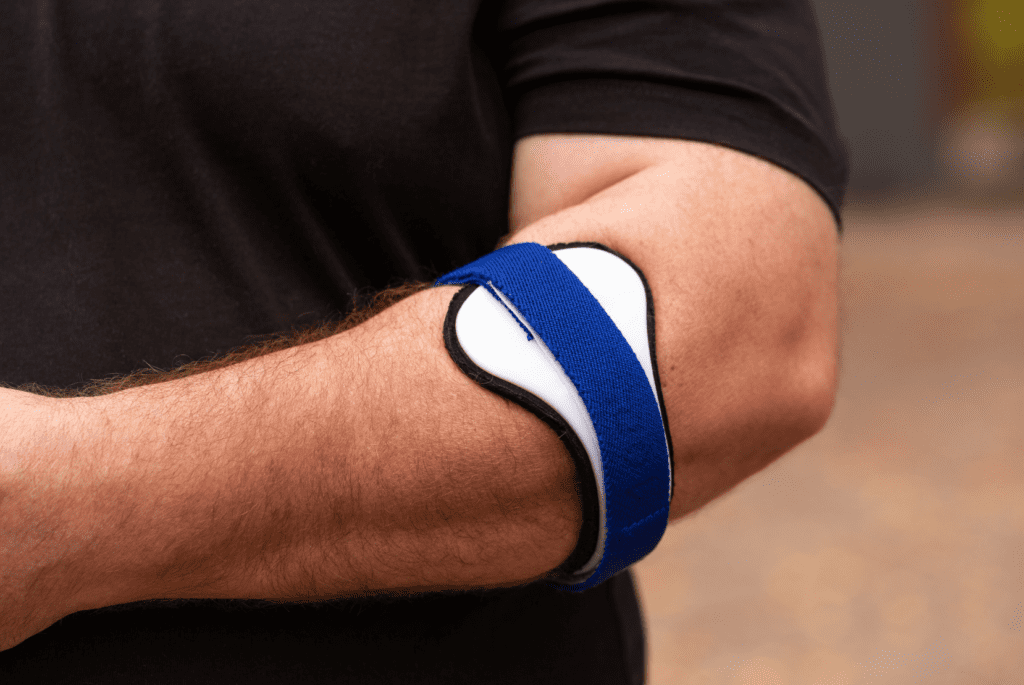
Part 5: The Brace Conversation. A Tool, Not a Crutch
Braces have a role. Let’s be clear about that. If you’re a tradesperson who needs to get through a workday and your symptoms flare with activity, a counterforce brace can be genuinely helpful for managing symptoms in the short term. It changes the angle of force transmission, offloading the irritated tendon just enough to allow you to function.
The problem is when the brace becomes a permanent solution. Here’s what happens:
- The brace manages symptoms, so you feel better.
- Because you feel better, you don’t change anything else.
- The underlying tendon continues to be deconditioned, but the brace masks that fact.
- Over time, the muscles and tendons that should be doing the work atrophy from underuse.
- You become dependent on the brace, and when you try to wean off, the pain returns and sometimes worse than before.
The brace is not a treatment. It’s a bridge. The goal is to use it strategically while you build the capacity in the tissue so you no longer need it. That capacity is built through graded loading, controlled movement, and tissue remodeling. It’s the exact things we’re doing with MRT and integrated exercise.
There is also a psychological component to brace reliance. When you depend on external support, your brain begins to associate movement without it as unsafe. This can increase sensitivity and reduce confidence in the joint. By gradually reducing reliance on the brace while building capacity, we restore both physical strength and psychological trust in the movement.
Part 6: The Science Supporting This Approach
While much of the research on IASTM focuses on general soft tissue conditions, there is specific evidence supporting its use for upper extremity tendinopathies.
A 2025 article on IASTM in hand therapy notes that research has demonstrated significant improvements in pain levels, joint range of motion, and functional outcomes in patients with lateral epicondylitis (tennis elbow) and other upper extremity conditions . The controlled micro-trauma created by IASTM initiates a localized inflammatory cascade that activates the body’s natural healing mechanisms, resulting in the production of new healthy tissue and improvement in functional capacity.
Additionally, the broader principles of mechanotherapy, which is the application of controlled mechanical loads to stimulate tissue repair, are well-established in the literature. As Kahn and Scott noted in their seminal 2009 paper, “Mechanotherapy” refers to the employment of mechanotransduction for the stimulation of tissue repair and remodeling. This is exactly what we’re doing when we combine MRT with active movement and progressive loading.
Finally, the concept of graded loading is now recognized as the gold standard for tendon rehabilitation. The NHS advises that “specific exercises to strengthen the forearm muscles and load the tendon are used” to increase the tolerance of the tendon to cope with normal activity levels. Our approach starting with tolerance, adding planes, then adding load is a direct application of this principle.
Emerging research in pain science also supports the use of integrated movement approaches. Interventions that combine sensory input, movement, and progressive loading tend to produce better long-term outcomes than passive treatments alone. This aligns with what we see clinically. Patients who actively participate in their treatment recover faster and maintain those results longer.
Part 7: What to Expect in a Session
If you come to Redbird Wellness for tennis or golfer’s elbow, here’s what your session might look like:
- Assessment: We’ll assess your range of motion, pain with specific movements, and identify exactly which tissues are most irritable.
- MRT Application: We’ll warm up the area, then begin the multi-directional scraping, starting within your tolerance.
- Integrated Movement: Once the tissue is responsive, you’ll begin moving through the affected motions while I maintain compression. We’ll explore wrist curls, deviations, pronation/supination, and potentially closed-chain work like planks.
- Progressive Loading: As you tolerate it, we’ll add a light dumbbell to the movements, continuing the MRT simultaneously.
- Home Program: You’ll leave with specific guidance on what to do between sessions. This will almost always include some form of graded loading. Exercises that challenge the tendon within your tolerance, not beyond it.
You may experience some mild discomfort during treatment and that’s normal and expected. The goal is not to cause pain, but to work within a tolerable range that produces a therapeutic response. You may also notice some temporary redness or mild bruising after the session, which is also common with IASTM and not to be alarmed with. Some practitioners will claim that bruising with IASTM is a good sign and more is better. This is untrue. Bruising from IASTM is the same as any other bruise and is a sign of acute inflammation. Our goal isn’t to make you bruised but it is a side effect that isn’t a contraindication to treatment but must be monitored.
It’s also important to understand that progress is measured in function, not just pain. Early wins might look like improved grip strength, better tolerance to daily tasks, or reduced stiffness rather than complete pain elimination. These changes indicate that capacity is improving, which is the ultimate goal.
The Takeaway: Build Capacity, Don’t Just Mask Pain
Tennis and golfer’s elbow are not life sentences. They are conditions of capacity where the tendon has lost its ability to tolerate the loads you’re asking of it. Bracing masks that loss. Rest perpetuates it. The solution is to rebuild capacity through controlled, progressive loading and tissue remodeling.
At Redbird Wellness, we combine the mechanical benefits of MRT with the biological imperative of movement to do exactly that. We desensitize the tissue, improve blood flow, apply targeted mechanical tension, and then we load it in ways that build real, lasting resilience.
If you’re in Hopkins, Minnetonka, or St. Louis Park and you’re ready to move beyond the brace, let’s talk. We’ll build a plan that gets your elbow back to doing what it needs to do without relying on external support to get you through the day.
Integrated movement is what bridges the gap between treatment and real life. It ensures that the improvements you make in the clinic actually transfer to how you use your arm at work, in the gym, or during sport. Without that integration, progress often stays temporary. With it, you build lasting change.
Ready to stop managing symptoms and start building real capacity? Schedule your consultation at Redbird Wellness and experience how integrated movement gets you back to pain-free function.
