
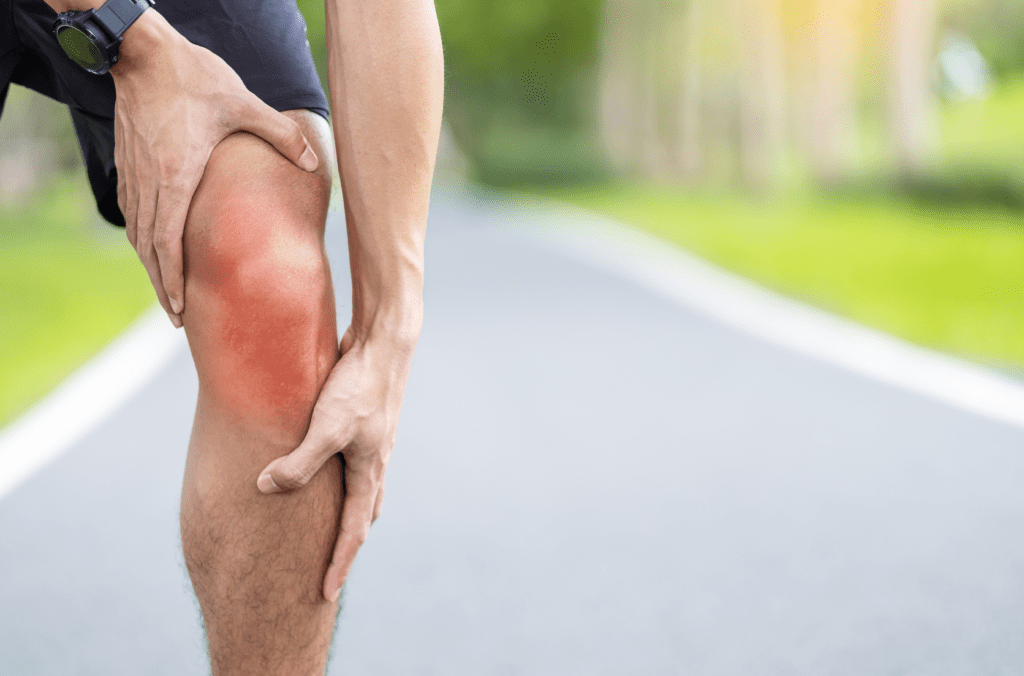
That familiar ache just below your kneecap. It starts as a dull soreness after a game, a workout, or a long run. Then it progresses. Pain during activity that may fade as you warm up, only to return with a vengeance afterward. If you’re a basketball player, volleyball player, a runner, or anyone who loads their knees through jumping, cutting, or squatting, you might be dealing with patellar tendinopathy.
Commonly called “jumper’s knee,” this condition affects about 8-10% of athletes, with rates as high as 30-40% in elite jumping and running sports. But here’s what most people miss. The problem isn’t just the tendon. The key to lasting relief often lies in the quadriceps.
Another major contributor we frequently see is load management failure. Most cases of patellar tendinopathy are not caused by a single traumatic event. They develop when the amount of force going through the tendon exceeds the tendon’s ability to recover from it. This often happens during periods of rapid training progression. More jumping, more sprinting, more lifting volume, more hill work, or even just a sudden increase in practice frequency without enough recovery capacity.
The tendon does not care whether the load came from sports, workouts, or life. We see patellar tendinopathy in athletes, but we also see it in people whose jobs require repetitive squatting, climbing, kneeling, or stair use. The common denominator is repeated tendon loading without adequate capacity to tolerate it.
At Redbird Wellness in Hopkins, we use dry needling to address both ends of the chain. The sensitive tendon itself and the tight, overactive quadriceps muscles that keep pulling on it.
What Patellar Tendinopathy Actually Is (And Isn’t)
The term “tendonitis” implies inflammation, and for years, treatment focused on ice, rest, and anti-inflammatories. But science has evolved. Patellar tendinopathy is better understood as a failed healing response; a degenerative condition of the tendon, not primarily an inflammatory one.
Think of it like this. The collagen fibers that make up your patellar tendon become disorganized and weak. The tendon loses its ability to tolerate the loads you’re asking of it. This is why rest alone doesn’t fix it because the tendon never gets the stimulus it needs to remodel.
This is also why many people get stuck in a frustrating cycle where they feel “better” after taking time off, only for the pain to immediately return once activity resumes. The rest reduced irritation temporarily, but the tendon never became stronger or more resilient. As soon as the original demand returns, the tendon reaches its limit again.
A healthy tendon is not just pain-free. It is capable of storing and releasing force efficiently. The patellar tendon functions like a spring during running, jumping, and landing. When the tendon loses its load tolerance, those forces stop being absorbed efficiently and the tissue becomes increasingly reactive.
Two Key Findings We Consistently See
- A painful, sensitive patellar tendon that is tender just below the kneecap, especially with the knee bent
- Tense quadriceps muscles with active trigger points which are muscle knots that create constant tension on the tendon
The second finding is often overlooked. Your quadriceps attach to your patella, which the patellar tendon then anchors to your shin. When the quadriceps are tight they pull constantly on the patellar tendon, never allowing it to relax and heal.
The Paradigm Shift – Tendons Need Load, Not Rest
This is the single most important concept in modern tendinopathy management. Tendons need mechanical load to heal.
According to the 2024 Dutch multidisciplinary guideline on patellar tendinopathy, exercise therapy is the primary recommended treatment. Not surgery, not injections, not passive modalities. The evidence is clear that loading the tendon under controlled conditions stimulates cellular repair and remodeling.
Current clinical recommendations include:
| Recommendation | Details |
| Exercise therapy first | 12+ weeks of quadriceps- and/or hip-focused loading |
| Pain monitoring | Pain ≤5/10 during activity is acceptable; modify if more severe |
| Don’t rest completely | Complete immobilization weakens the tendon further |
| Patients can continue pain-monitored sport | Those who continue activity (with pain limits) show similar recovery to those who stop completely |
This point surprises many athletes because older advice centered around complete shutdown of activity. Current evidence suggests that intelligently modified loading is often more effective than total rest. Completely unloading the tendon for long periods may actually reduce the tissue’s tolerance further, making return to sport even harder.
The key is dosage. A tendon can usually tolerate some discomfort during rehab. Pain does not automatically equal damage. In fact, mild, tolerable symptoms during loading are often expected during recovery. The important distinction is whether symptoms calm back down appropriately afterward or progressively worsen over time.
The 2024 Dutch guideline acknowledges that while the evidence for exercise is “low GRADE,” the expert panel strongly advocates its use as the primary treatment due to clinical consensus and the absence of better alternatives.
But here’s the challenge. Loading a painful tendon is difficult.
This is where isometrics can become incredibly valuable early in the rehab process. Isometric loading means producing force without significant joint movement, such as holding a wall sit or a Spanish squat. These exercises often reduce tendon pain temporarily while still giving the tendon meaningful mechanical input.
For many people with patellar tendinopathy, isometrics become the first step that allows them to tolerate heavier loading later. Once symptoms become more manageable, rehab progresses toward eccentric work, slow heavy resistance training, and eventually plyometrics and sport-specific movements.
If the contact of the needle itself proves beneficial, we can pair it with gentle loading within tolerance, we form a “bridge” back to full-strength rehab.
How Dry Needling Works for Patellar Tendinopathy
Dry needling addresses this problem from two angles.
1. Deactivating Quadriceps Trigger Points
Research has demonstrated that dry needling to trigger points (TrPs) in the vastus medialis oblique (VMO), vastus lateralis (VL), and rectus femoris produces significant improvements in pain and function. A 2020 randomized controlled trial found that trigger point dry needling combined with stretching resulted in:
- Significant decreases in pain (VAS scores)
- Significant improvements in functional status (Kujala scores)
- Improved coordination between the VMO and VL (VMO/VL ratio)
These changes lasted for at least 3 months after a 6-week treatment course.
The mechanism is straightforward. Trigger points create chronic tension in the quadriceps which pulls on the patellar tendon. Releasing those trigger points reduces the resting tension, allowing the tendon to heal.
We commonly find trigger points not just in the rectus femoris, but throughout the entire anterior thigh complex. The vastus lateralis in particular is often extremely reactive in jumping athletes and runners. When these tissues remain chronically overactive, the tendon experiences a constant baseline tension even outside of activity.
This matters because tendons recover between loading sessions. If surrounding tissues never truly relax, the tendon may remain mechanically irritated for far longer than it should. Reducing quadriceps tone creates a more favorable environment for tendon remodeling and recovery.
2. Direct Needling of the Tendon
We also needle the patellar tendon itself. While the exact mechanism isn’t fully understood, the clinical evidence supports its effectiveness.
A 2024 randomized trial compared dry needling combined with eccentric exercise to the same exercise plus a platelet-rich plasma (PRP) injection. The findings were striking:
- Both groups improved significantly from baseline
- The DN-only group showed slightly better VISA-P scores at 12 weeks (28 vs. 19 points; p < 0.05)
- PRP added no additional benefit over dry needling alone
The authors concluded: “Both DN and DN plus LP-PRP are effective treatment options . . . however, LP-PRP did not add any additional improvement over DN alone.”
What explains the benefit? The mechanical insertion of the needle likely:
- Creates controlled microtrauma that triggers a local healing response
- Breaks up disorganized collagen and stimulates realignment
- Influences pain sensitivity through mechanotransduction pathways
This controlled stimulation appears to influence both the tendon tissue itself and the nervous system surrounding it. Chronic tendinopathy is not purely a structural problem. Pain sensitivity changes over time. The tendon and surrounding tissues become more reactive and protective. Mechanical stimulation through dry needling may help alter that sensitivity while also encouraging local tissue remodeling.
That is one reason some patients notice changes quickly even though tendon remodeling itself takes much longer. Pain reduction and improved tolerance can occur before the tendon has fully structurally adapted. This early improvement is important because it allows rehabilitation to progress instead of stalling due to pain.
What Dry Needling Feels Like for Patellar Tendinopathy
If you’ve never experienced dry needling, the anticipation is often worse than the treatment. Here’s what to expect:
During the Needling
- Twitch responses: When we hit an active trigger point in your quadriceps, you’ll feel a brief, involuntary twitch. This is the “reset” that lasts a fraction of a second and is a sign that the muscle is releasing.
- Sharp sensations: The needle insertion itself may feel like a quick, sharp pinch. Some patients also describe a brief electric or cramping sensation when we needle the tendon directly.
- Overall experience: Most patients tolerate dry needling very well. The discomfort is brief and far outweighed by the results.
After the Needling
- Mild soreness is normal. You may feel sore for 24-48 hours, similar to the sensation after a challenging workout (DOMS).
- Temporary relief often follows. Many patients report an immediate reduction in tension and pain, with continued improvement over the following days.
Many patients also report that the knee feels “lighter” or less restricted immediately afterward. Movements like stairs, squats, or walking after prolonged sitting often feel smoother because the surrounding quadriceps tension has decreased.
This does not mean the tendon is fully healed after one session. Patellar tendinopathy still requires progressive loading over time. But creating an early reduction in pain and tension often improves compliance dramatically because patients are finally able to move without feeling like every step irritates the tendon.
We always follow your lead. Some patients proceed immediately to loading exercises while the tissue is primed while others need a session of rest or other manual therapies before reintroducing load. Your response determines the pace.
Who Should (and Shouldn’t) Try This Approach
This APPROACH IS for:
| Patient Type | Why It Fits |
| Jumping/cutting athletes | Basketball, volleyball, track, soccer, tennis – you’ve tried ice and rest; it’s time for active intervention |
| Runners who increased intensity too fast | Patellar tendinopathy often emerges after a rapid increase in mileage or hill work |
| Non-athletes with repetitive knee loading | Squatting at work, climbing stairs, kneeling – you need a solution that restores capacity |
| Those who’ve failed rest/ice/massage alone | Stretching and rolling the quad improves symptoms temporarily, but rarely resolves the condition |
This approach IS NOT for:
- Acute swelling post-injury (first few days)
- Suspected patellar tendon rupture – seek immediate evaluation
- Significant night pain that wakes you – may indicate a different pathology
- Failure to improve after 6+ months of quality conservative care – consider advanced imaging
One of the biggest misconceptions about patellar tendinopathy is that imaging severity predicts pain severity. In reality, imaging findings and symptoms do not always correlate well. Some athletes with obvious tendon degeneration on ultrasound or MRI function relatively well, while others with milder imaging findings experience significant pain.
This is important because treatment decisions should not be based solely on imaging. Your symptoms, movement tolerance, strength deficits, and functional limitations matter more than what a scan looks like in isolation.
According to the 2024 Dutch guideline, surgery is reserved for very specific cases of non-responders who have failed at least 12 weeks of structured exercise therapy with additional conservative treatments. Most patients never need it.
The Takeaway… Dry Needling as a Bridge
The modern approach to patellar tendinopathy centers on progressive mechanical loading. The tendon needs to be stressed in order to remodel and strengthen.
But that’s exactly the problem because you can’t load what you can’t tolerate.
If the tendon is too painful to load with heavy weights, the rehabilitation process stalls. Research indicates that achieving muscle activation levels sufficient for tendon adaptation can be challenging, particularly in the early stages, when pain limits effort.
Dry needling serves as a bridge:
- It deactivates the quadriceps trigger points that constantly pull on the tendon
- It directly influences the tendon’s pain sensitivity and healing response
- It creates a window of reduced pain where loading exercises become possible
- This allows a more tolerable entry into the rehabilitation process
A successful rehab progression usually follows a very predictable sequence: calm the pain enough to tolerate loading, rebuild baseline strength and tendon tolerance, then gradually reintroduce speed, elasticity, and sport-specific force production. Many people try to skip directly back into explosive activity before rebuilding the foundation underneath it. That shortcut is one of the biggest reasons symptoms keep returning.
Patellar tendinopathy recovery also requires patience. Tendons remodel more slowly than muscles. A muscle may feel better in days. Tendons often need weeks to months of consistent loading to fully adapt. The process can absolutely work, but consistency matters more than chasing quick fixes.
Once that window opens, we can load the tendon effectively with eccentric declines, isometric holds, and controlled plyometrics that build real capacity.
Ready to Address the Real Source of Your Knee Pain?
If you’re in Hopkins, Minnetonka, or St. Louis Park and you’re tired of the “rest and ice” cycle that never quite works, we offer a different approach. We’ll assess both your quadriceps and your patellar tendon, determine whether trigger points are driving the problem, and build a plan that addresses both.
Schedule a visit at Redbird Wellness to explore whether dry needling is right for your patellar tendinopathy.
