
There’s a specific kind of being overwhelmed that doesn’t look dramatic from the outside. You’re still showing up. Still responding to texts. Still doing the things. But internally, your chest feels tight, your thoughts won’t slow down, and everything (and I mean everything) feels like too much. If you’re overwhelmed right now trying to keep up with every demand from life, I want to say this clearly: nothing is “wrong” with you. You’re responding to a system that rewards overextension and punishes rest, especially in women.
We live in a world that treats burnout like a personal failure instead of a predictable outcome from unsustainable systems. We’re told to push through, be resilient, try harder, and somehow magically feel better while doing nothing differently. And then we’re surprised when anxiety spikes, resentment builds, and our bodies start waving red flags we can’t ignore.
Here’s the part I talk about with clients all the time and the part that tends to feel both empowering and deeply uncomfortable: you have a conscious choice to make. Just sit with that for a moment, you have a choice. Not about everything. Not about what’s already happened. But about what you continue to say yes to when you’re already overwhelmed.
Overwhelm Isn’t a Personal Defect
Being overwhelmed doesn’t mean you’re weak, incapable, have less skills than the woman next to you, or are “bad at life.” It usually means you’ve been strong for too long without enough support. It means you’ve been adapting. Carrying things. Managing stress quietly. Holding it together when there wasn’t another option.
The problem is that overwhelm doesn’t announce itself politely. It shows up as irritability, anxiety, brain fog, exhaustion, and that low-level dread that hums in the background of your day. It shows up as snapping at people you love or shutting down entirely. And if you ignore it long enough, it will escalate. Not because it’s dramatic (or that you’re dramatic), but because it needs your attention.
Overwhelm is information. Not a verdict.
The Lie We’ve Been Sold About “Handling It”
Somewhere along the way, many of us learned that capable, successful people don’t slow down. That rest is earned. That saying no is selfish. That if we just organize better, hustle smarter, or manage our time more efficiently, we won’t feel like this anymore.
That’s complete bullshit.
You can be highly competent and still be overwhelmed. You can love your job and still be exhausted. You can want connection and still need space. These things are not mutually exclusive, even though we’re often taught they are.
What actually keeps people stuck isn’t lack of skill, it’s the belief that slowing down is a failure instead of a choice.
You Have More Control Than Anxiety Wants You to Believe
When anxiety ramps up, it convinces you that everything is urgent. That every request is important. That if you don’t say yes now, something terrible will happen. Anxiety thrives on speed. Overwhelm thrives on momentum.
Slowing down interrupts both.
This doesn’t mean quitting your job, canceling every plan, or moving to the woods (unless that’s your thing, no judgment and like, I get the urge). It means recognizing that you can pause before responding. You can check in with yourself. You can ask, “Do I actually want to do this?” or “Do I have the capacity for this right now?” and let the answer matter.
That moment, the pause, is where your power lives.
Saying No Is Not a Character Flaw
Let’s talk about saying no, because this is where people really struggle. Saying no doesn’t mean you don’t care. It doesn’t mean you’re inconsiderate, inflexible, dramatic, or difficult. It means you’re paying attention to your limits.
A lot of people were taught that their worth comes from being agreeable, helpful, or endlessly available. Especially women. Especially caretakers. Especially people who learned early on that keeping the peace mattered more than honoring their own needs.
But here’s the reality: every yes costs you something. Time. Energy. Emotional bandwidth. And when you’re already overwhelmed, continuing to say yes isn’t generous, it’s self-abandonment.
You’re allowed to protect your capacity. You’re allowed to disappoint people. You’re allowed to choose yourself without writing a five-paragraph justification.
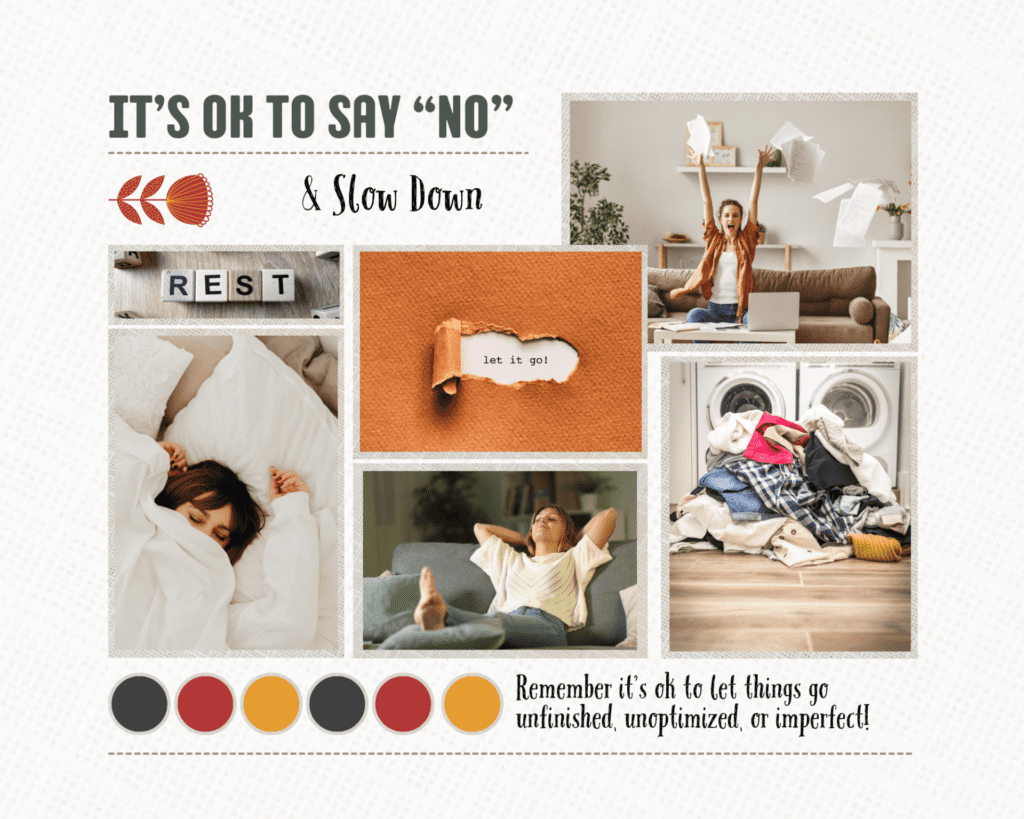
Slowing Down Doesn’t Mean You’re Giving Up
One of the biggest fears I hear is, “If I slow down, everything will fall apart.” Or, “If I say no now, I’ll never get back on track.” That fear makes sense, especially if you’ve been the glue holding things together for a long time.
But slowing down isn’t quitting. It’s recalibrating. If you have to run this hard and this fast to keep everything, maybe this wasn’t meant for you. At least not in this way.
It’s choosing sustainability over survival mode. It’s recognizing that your nervous system cannot operate at emergency levels forever without consequences. Slowing down is not passive. It’s intentional. It’s active care.
And yes, it can feel wildly uncomfortable at first, especially if you’re used to moving fast to avoid feeling things. That doesn’t mean it’s wrong. It means it’s different.
Overwhelm Is Often a Boundary Issue in Disguise
When people feel overwhelmed, they often look for internal fixes: mindset shifts, coping skills, self-care routines. And those things can help. But overwhelm is frequently about external overload, not internal failure.
Too many commitments. Too many expectations. Too many roles. Too many people needing something from you.
You can’t breathe better in a room that’s on fire. Sometimes the work isn’t calming yourself down, it’s stepping out of what’s burning you out.
Boundaries aren’t about controlling other people. They’re about controlling your participation. And yes, that might mean letting some things go unfinished, unoptimized, or imperfect. That’s not a crisis. That’s being human.
You Don’t Need to Earn Rest
This one deserves its own section, because so many people believe rest is a reward for productivity. That you can slow down after you’ve done enough, helped enough, achieved enough.
But rest is not a luxury item. It’s a biological need.
You don’t have to collapse to justify taking care of yourself. You don’t need permission. You don’t need to reach a breaking point. Waiting until you’re completely depleted before you slow down is like waiting for your car to break down before getting an oil change.
Preventative care counts.
Choosing Yourself Is an Ongoing Practice
Here’s the thing no one tells you: choosing yourself once doesn’t magically cure overwhelm. This is a practice. A series of small, often boring decisions that add up over time.
It’s declining an invite. Logging off earlier than usual. Letting the house be messy. Rescheduling something non-essential. Saying, “I don’t have it in me today,” and not apologizing for it.
These choices won’t make you instantly zen. But they will build trust with yourself. And that trust matters more than perfection.
If You’re Overwhelmed, This Is Your Permission Slip
If no one has told you lately, let this be the reminder: you are allowed to slow down (in fact, if you’re reading this, please do). You are allowed to say no. You are allowed to opt out of things that drain you, even if other people don’t understand.
Being overwhelmed isn’t a sign you’re failing at life. It’s a signal that something needs to change and you get to decide what that change looks like.
You don’t need to burn your life down. You don’t need a dramatic reset. You just need to start choosing yourself in small, consistent ways, even when it feels uncomfortable.
Especially when it feels uncomfortable.
If you’re feeling overwhelmed and stuck in survival mode, you don’t have to figure it out alone. Schedule a consultation and let’s talk about what slowing down could look like for you.