
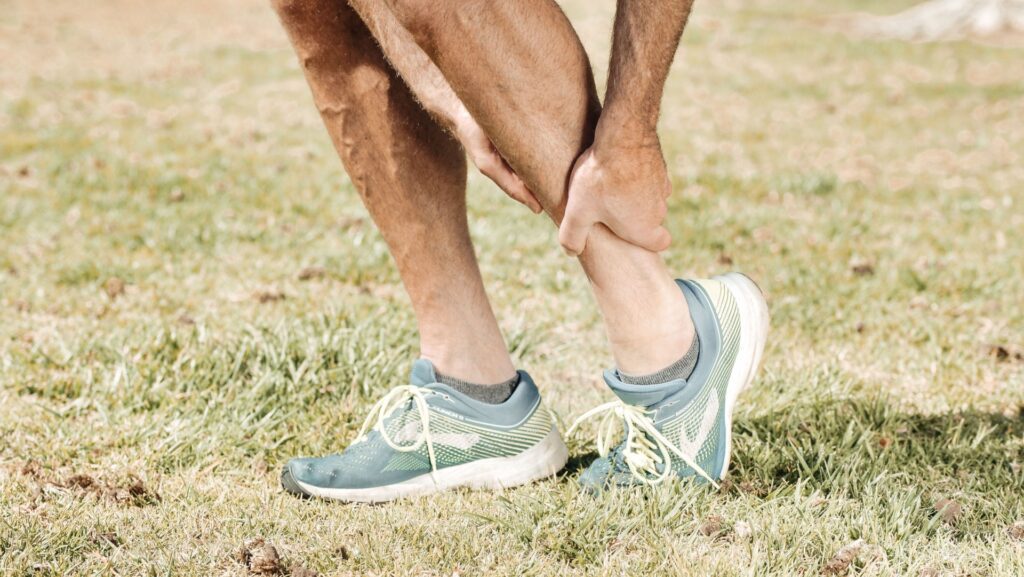
If you’ve got that stiff, achy feeling in the back of your heel that’s worse for your first few steps in the morning, loosens up once you’re moving, and then creeps back after a run or a long day on your feet, you’re dealing with something extremely common, extremely treatable, and extremely misunderstood. Most people call Achilles tendinopathy, “Achilles tendinitis.” Most people also treat it wrong, because that name points them toward rest and ice when what the tendon actually needs is the opposite. This is the long version, what’s actually happening in the tendon, the myths that keep people stuck, and why treatment in this office isn’t just “here’s a stretch, good luck,” but a combination of hands-on work and a real rehab plan.
The Condition, Deep Dive
Your Achilles tendon is the thick band connecting your calf muscles (the gastrocnemius and soleus) down to your heel bone (the calcaneus). Every step, run, jump, and stair climb sends force through it. It’s built to handle enormous load, repeatedly, for decades. Tendinopathy happens when the demand placed on that tendon outpaces its current capacity to handle it.
That word, capacity, matters more than almost anything else in this article. Tendons are living tissue. They adapt to load, the same way muscle does, by remodeling their internal structure over time. When the demand you’re asking of the tendon rises faster than it can adapt, a sudden jump in mileage, a new hilly route, a change in footwear, more time on your feet than usual, the collagen fibers that make up the tendon start to become disorganized rather than neatly aligned. That disorganized structure is weaker, less able to store and return energy efficiently, and it’s what shows up as pain, stiffness, and sometimes visible thickening of the tendon.
Something that’s important to understand here is that tendon capacity isn’t determined only by what you did yesterday. It’s influenced by what the tendon has been prepared to do over the previous weeks and months. Someone who regularly runs 20 miles per week may tolerate a six-mile run without a problem, while the same six-mile run could be a major spike in demand for someone who has been running five miles per week. The activity itself isn’t necessarily the problem. The gap between the demand and the tissue’s current capacity is.
This is also why Achilles tendinopathy can seemingly appear after an activity you’ve done plenty of times before. The run, workout, or long weekend on your feet may simply be the final piece of a larger accumulation of load. Changes in training frequency, recovery time, intensity, terrain, and even how much walking you’re doing outside of exercise all contribute to the total amount of work the tendon has to absorb.
There are two distinct types, and knowing which one you have actually changes the treatment plan:
Mid-portion Achilles tendinopathy shows up 2 to 6 centimeters above where the tendon attaches to the heel, roughly the narrowest part of the tendon, where blood supply is naturally more limited. This is the more common presentation, especially in runners.
Insertional Achilles tendinopathy shows up right where the tendon meets the heel bone itself. It behaves differently because that location involves compressive forces against the bone, not just tensile pulling. Positions that stretch the tendon into deep dorsiflexion like the bottom of a deep heel drop off a step, can actually aggravate insertional tendinopathy instead of helping it, because they compress the tendon against the bone at exactly the wrong angle. Same tendon, same general principle of needing progressive load, but the specific exercises and ranges of motion used need to be adjusted based on which one you have.
Symptoms usually build gradually rather than appearing overnight: stiffness and pain for the first several minutes after getting out of bed or standing up after sitting, that eases with movement, followed by pain that returns after activity, sometimes hours later, sometimes the next morning. Some people notice a thickened or tender area on the tendon itself. Pain that comes on suddenly with a “pop” and makes it hard to push off or walk normally is a different situation entirely that’s worth getting checked immediately, since it can indicate a partial or full tendon tear rather than tendinopathy, and that changes everything about how it needs to be managed.
Another useful clue is how symptoms respond over a full 24-hour period. Achilles tendinopathy doesn’t always tell you immediately that you’ve done too much. You may get through a run or workout feeling relatively good and notice significantly more stiffness the following morning. That delayed response gives us useful information about how well the tendon tolerated the previous day’s load. Tracking morning stiffness, pain with your first few steps, and how quickly those symptoms settle can therefore be just as useful as paying attention to pain during exercise itself.
As for why this develops in the first place: it’s almost never one clean explanation. A jump in training volume, tighter calves than usual, worn-out or unsupportive shoes, a change in running surface or terrain, less sleep and recovery than your body’s used to, tendons naturally becoming a little less resilient with age. Even things like stress and overall life load affecting how well your body recovers between sessions. Usually it’s a handful of these stacking up at the same time, past what the tendon had adapted to handle. That’s also why “just stop running” rarely solves it on its own. The goal isn’t identifying the one thing to eliminate. It’s rebuilding the tendon’s capacity so it can handle the full picture of your life again.
Mythbusting
Myth #1: It’s inflamed, so resting it and icing it will calm it down.
The “-itis” in tendinitis means inflammation, and that name shaped how this condition was treated for decades: rest it, ice it, take an anti-inflammatory, wait for the inflammation to settle. The problem is that once Achilles pain has been around for more than a few weeks, research going back over twenty years has consistently shown active inflammation typically isn’t what’s driving the pain anymore. That’s precisely why the medical language shifted from tendinitis to tendinopathy. What’s actually there is a capacity problem, not a hot, inflamed one. Resting a tendon that’s lost capacity doesn’t rebuild that capacity. It lets it keep declining, which is a big part of why so many people rest for weeks, feel a little better, go back to their normal activity, and have the pain come roaring back almost immediately.
That doesn’t mean activity should continue completely unchanged either. There’s a difference between total rest and temporarily modifying load. If your normal running mileage repeatedly leaves the tendon significantly worse the following day, continuing that exact workload isn’t helping it adapt. We may temporarily change mileage, speed, hills, jumping, or another aggravating variable while maintaining as much activity as the tendon can currently tolerate. The goal is to find enough load to stimulate adaptation without repeatedly overwhelming the tissue.
Myth #2: There’s one correct exercise, and if you’re not doing it exactly right, you’re not fixing anything.
The famous “heel drop” protocol, slowly lowering off a step, done twice a day for weeks, is well known for a reason. It was one of the first loading protocols studied for this condition, and it’s the research that first proved loading, not rest, was the answer. But more recent studies comparing it against other loading approaches, like heavier resistance training such as weighted calf raises, have found those work just as well, and in some measurements, tendon stiffness, cross-sectional area, even better. The specific exercise matters far less than the underlying principle: progressively asking the tendon to handle more than it’s currently comfortable with, consistently, over weeks. If you’ve ever worried you did the “wrong” exercise and ruined your progress, you very likely didn’t. There isn’t one narrow path back from this, which is genuinely good news.
Myth #3: If it hurts during the exercise, you’re making it worse.
This is one of the most common reasons people quietly stop doing their rehab. A tendon that’s already sensitive is often going to produce some discomfort when you load it on purpose, and a certain amount of that is expected and not a sign of damage. The general guideline used in modern rehab is that mild-to-moderate discomfort during the exercise that settles back down by the next morning is acceptable and often part of the process; sharp pain, pain that keeps climbing during the set, or pain that’s noticeably worse the next day and staying worse are the signals to actually back off. That’s a meaningfully different message than “any pain means stop,” and it’s one of the biggest reasons people either quit a program that was actually working, or don’t push hard enough for it to work in the first place.
Myth #4: Stretching the Achilles more will make it heal faster.
Stretching can feel good when your calf and ankle feel stiff, but more stretching isn’t automatically better for Achilles tendinopathy. This is especially important with insertional symptoms. Aggressively driving the ankle into dorsiflexion increases compression where the tendon attaches to the heel, potentially irritating an already sensitive area.
Whether stretching belongs in the plan depends on where your symptoms are located, how much ankle mobility you actually have, and how the tendon responds. Sometimes improving calf or ankle mobility is useful. Sometimes the better first move is reducing compression and building strength within a more comfortable range before gradually introducing deeper positions.
Manual Therapy: Why and How It Helps
To be direct about this upfront: manual therapy isn’t the fix for Achilles tendinopathy on its own. It doesn’t replace the loading work described below. The research on combining hands-on treatment with a real loading program consistently shows better results than either one alone, which is exactly why we don’t do one without the other.
Scraping (IASTM): Using an instrument to apply controlled pressure across the calf and the tendon itself does two things with decent evidence behind them. First, it’s been shown to meaningfully improve ankle dorsiflexion range of motion, and since restricted ankle mobility is one of the contributing factors that can overload the Achilles in the first place, improving it takes some of that accumulated load off the tendon directly. Second, a study comparing eccentric exercise alone to eccentric exercise combined with instrument-assisted soft tissue work found the combination outperformed exercise alone, for both short and long-term outcomes. It’s not magic and it’s not standalone. It’s a legitimate way to open up mobility and support the loading program doing the heavier lifting.
Dry needling: For Achilles issues, this is typically targeting tight, restricted spots in the calf muscles themselves, the gastrocnemius and soleus, rather than the tendon directly. Tight calf muscles increase the tension the tendon has to manage with every step, so releasing that tightness is another way of reducing the total load stacking up on the tendon. Research comparing dry needling to IASTM for calf tightness in runners found both effective, with dry needling showing a bit more benefit for reducing muscle tenderness and tightness specifically, which is why the two often make sense as complementary tools rather than either/or.
Ankle joint mobilization/manipulation: Restricted motion at the ankle joint itself (not just tight calf muscle, but the actual joint mechanics) is a well-documented contributor to Achilles overload, since a stiff ankle joint forces the tendon and surrounding tissue to compensate for motion that should be happening at the joint. Restoring that joint’s normal glide and range takes some of that compensatory demand back off the tendon.
E-stim: This one’s more supporting cast than headliner. Electrical stimulation doesn’t rebuild tendon structure, but it’s a genuinely useful tool for taking the edge off pain and irritability, especially early on when a tendon is more reactive. Making the area more comfortable can be what allows someone to actually tolerate and complete their loading exercises consistently which, given everything above, is the part doing the real long-term work.
This is also why we don’t judge treatment success solely by whether the Achilles feels better immediately after an appointment. Short-term symptom relief is useful when it allows you to move and load the tendon more comfortably, but the bigger question is what you can do with that change. Can you tolerate more resistance? Move through a greater range? Walk farther? Eventually return to running or jumping without the tendon becoming increasingly reactive? Manual therapy creates an opportunity. Rehab is what turns that opportunity into capacity.
Rehab: What Adaptations We’re Looking For, and Why They Matter
The entire point of a structured rehab program here is to change the physical properties of the tendon itself, not just make the pain quiet down temporarily. Research on progressive loading programs shows measurable increases in tendon stiffness and cross-sectional area after a properly run program. Both of those matter directly: a stiffer, more robust tendon can store and return force more efficiently, which means it can handle your normal training and daily activity without tipping back over into pain. That’s the actual target, not just “does it hurt less today.”
Getting there is a graded process, not a single exercise handed to you on day one:
Early stage — building tolerance. If the tendon is particularly irritable, we often start with isometric holds (sustained, static loading rather than moving through a full range) since these tend to be well tolerated even by a reactive tendon and can help settle pain while still providing a loading stimulus, rather than the tendon getting nothing at all.
For patients who are especially deconditioned, post-injury, or simply can’t tolerate meaningful load yet without a significant flare, blood flow restriction training can be a genuinely useful bridge here. It allows real strength stimulus to the calf and tendon complex using much lighter loads than would normally be required, which matters when heavier loading isn’t realistic yet but doing nothing lets the tendon keep losing capacity.
Middle stage — progressive strengthening. This is where the bulk of the work happens: consistent, progressively heavier loading of the calf complex, whether through the classic eccentric heel drop approach or heavier slow resistance training like weighted calf raises. The exact exercise selection depends on whether you’re dealing with mid-portion or insertional tendinopathy, since the range of motion and angles used need to respect which type you have. This stage typically runs 8 to 12 weeks at minimum, genuinely longer than most people expect coming in, and longer than most people stick with a home program on their own, which is a big part of why so many cases stall out or come back.
One detail that matters during this stage is training both major calf muscles. Straight-knee calf raises emphasize the gastrocnemius, while bent-knee calf work places greater demand on the soleus. Both muscles feed into the Achilles tendon, and both contribute to walking, running, and pushing off the ground. Building only one part of the calf complex can leave a gap between what you’ve strengthened in rehab and what the tendon needs to handle during real activity.
Late stage — returning to demand. Once strength and tolerance are solid, especially for runners, jumpers, or anyone returning to a sport, the program needs to progress toward the kind of fast, elastic, energy-storing loads those activities actually demand. Think hopping and plyometric work. Not just slow, controlled strengthening. Skipping this stage is a common reason someone feels “better” in the clinic but re-aggravates the tendon the moment they return to real running or sport.
A calf raise and a sprint ask very different things from the Achilles. Slow resistance helps build force capacity, but running and jumping require the tendon to absorb, store, and release that force quickly. That’s why returning to sport based only on pain reduction can be premature. We want the tendon exposed to progressively faster and more demanding tasks before asking it to suddenly handle full-speed activity again.
How Do You Know When You’re Ready to Return to Running?
There isn’t one universal number that clears everyone to run again. Instead, we look at how the tendon responds to progressively harder tasks. Can you perform repeated calf raises with good control? Can you tolerate hopping without a meaningful increase in symptoms? Has your morning stiffness remained stable as your training load increases? Those markers tell us much more than simply asking whether the tendon hurts while you’re sitting in the office.
Returning to running is usually another progression rather than an on/off switch. That may mean starting with shorter distances, slower speeds, flatter terrain, or run-walk intervals before rebuilding toward your previous mileage. Hills and speed work can be layered back in as capacity improves. The same principle that caused the problem applies to the return: demand shouldn’t suddenly outrun capacity again.
Why all of this matters, ultimately, comes back to the same idea running through this whole article: Achilles tendinopathy isn’t caused by one single thing, and it doesn’t get fixed by one single thing either. It’s the accumulation of manageable pieces like tendon capacity, calf and ankle mobility, training load, and enough time for real tissue adaptation; all moving in the right direction together. That’s also exactly why doing this properly, rather than guessing your way through a program you found online, tends to be the difference between this resolving for good and it becoming the nagging issue that never quite goes away.
Ready to Get Your Achilles Moving Again?
If Achilles tendinopathy is keeping you from running, training, or simply moving without constantly thinking about your heel, it’s worth figuring out what your tendon actually needs instead of cycling through rest and flare-ups. At Redbird Wellness, we’ll assess your Achilles, ankle mobility, calf function, current activity demands, and overall movement to build a treatment and rehab plan around your specific presentation.
Ready to get started? Schedule a consultation with Redbird Wellness today and let’s build your Achilles back up for the things you actually want it to do.
