
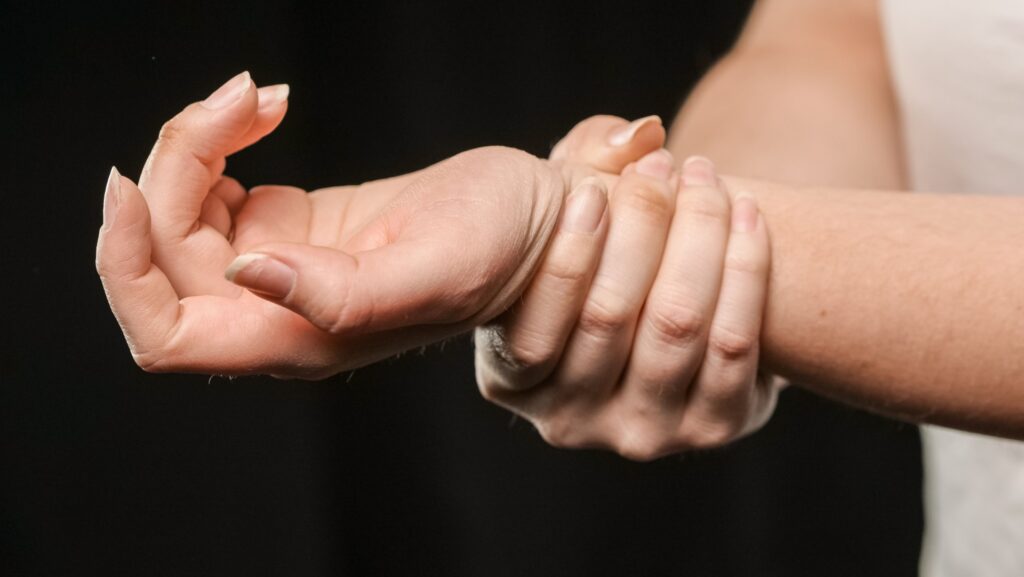
If you wake up at 3 a.m. shaking out a numb, tingling hand, drop your coffee mug for no obvious reason, or notice your thumb, index, and middle fingers go fuzzy while you’re driving or scrolling your phone, there’s a good chance someone has already told you it’s carpal tunnel. It’s one of the most common nerve problems in the body, showing up in roughly four out of every hundred people, and it’s one of the most commonly misunderstood.
Most people hear “carpal tunnel” and picture a single swollen spot in the wrist that needs to be fixed with a brace or a surgery. The real picture is more interesting, and a lot more hopeful.
This is the long version: what’s going on inside the wrist, what the research says actually helps, how hands-on treatment fits in, and what a real rehab plan looks like. It’s also a story that doesn’t stop at the wrist, because the nerve involved starts a lot higher up than most people realize.
The Condition, Deep Dive
The carpal tunnel is a narrow passageway at the base of your palm. The floor and sides are made of small wrist bones arranged in an arch, and the roof is a thick band of connective tissue called the transverse carpal ligament.
Through that tight space run nine flexor tendons that bend your fingers and thumb, plus the median nerve, which carries sensation from your thumb, index finger, middle finger, and half of your ring finger, and powers some of the small muscles at the base of your thumb. Everything in that tunnel is sharing very limited room.
Carpal tunnel syndrome happens when pressure inside that space climbs high enough to irritate the median nerve. The numbers are striking. In people with carpal tunnel syndrome, pressure inside the tunnel at rest has been measured around 32 mm Hg, compared to roughly 2.5 mm Hg in people without symptoms.
Bend the wrist forward and that number climbs to about 94 mm Hg; extend it backward and it reaches around 110. Healthy wrists see increases too, but nowhere near as steep. That’s a big part of why symptoms flare in specific positions: gripping a steering wheel, holding a phone, typing with the wrists angled, or sleeping with the hands curled under a pillow.
That last one deserves its own explanation, because night symptoms are the hallmark of this condition. When you lie down, fluid shifts toward your arms, your muscles stop pumping, and your body’s natural cortisol dips overnight, all of which allow pressure in the tunnel to creep up while you sleep.
A nerve that’s already irritated doesn’t like that. So you wake up with a hand that feels like it’s full of static, shake it out, and it settles. That “flick sign” is so characteristic that clinicians ask about it directly.
The nerve itself is also not a fixed cable. The median nerve slides back and forth through the tunnel as your wrist and fingers move, traveling up to nearly a centimeter with wrist flexion. When the tissues around it get crowded or sticky, that sliding gets restricted, and the nerve gets tugged and compressed at the same time.
Prolonged pressure also affects the nerve’s blood supply, which is why symptoms tend to start as intermittent tingling, progress to more constant numbness, and, if left alone long enough, can lead to weakness and shrinking of the muscle at the base of the thumb.
Here’s where it gets interesting for anyone expecting a single clean answer: most cases of carpal tunnel syndrome don’t have one. The research calls the majority idiopathic, meaning no single identified driver. What shows up instead is an accumulation of contributing factors that tend to stack together:
- Genetics and anatomy. In women especially, family history is among the strongest predictors, and the shape and size of the carpal bones and tunnel itself vary from person to person.
- Hand and wrist demands. Repetitive gripping, sustained wrist flexion or extension, forceful hand work, and vibration from tools all raise tunnel pressure over time.
- Body-wide factors. Higher body mass index, pregnancy, diabetes, thyroid problems, and inflammatory conditions are all associated with higher risk, likely because they change the amount of fluid or tissue crowding the tunnel.
- What’s happening upstream. The median nerve doesn’t begin at the wrist. It’s built from nerve roots exiting the lower neck, passes through the shoulder girdle, the upper arm, and the elbow before it ever reaches the carpal tunnel. A nerve that’s been irritated or restricted at one point along that path can be more sensitive to pressure further down, which is the idea behind what’s called “double crush.” It’s a debated concept, and researchers don’t agree on how often it plays a role, but in one review of 350 people with neck-level nerve root problems, 279 also had median nerve symptoms at the wrist. That’s a lot of overlap to ignore.
That’s a long list, and it points to something practical: you don’t have to fix every item. The useful question is which two or three are actually modifiable for you.
For some people that’s how their wrist is positioned for eight hours at a desk. For others it’s night positioning, grip-heavy work habits, or tension through the neck and shoulder girdle that’s pulling on the nerve from above. That’s how we approach it here: find the pieces that can realistically change, change them, and measure whether your symptoms follow.
One thing worth saying clearly, because it matters for safety: not every tingly hand is a mild, manageable carpal tunnel. Constant numbness that doesn’t come and go, visible shrinking of the muscle at the base of your thumb, or real weakness when you try to pinch or grip are signs the nerve is under more stress than conservative care alone is likely to solve, and those warrant a referral for formal nerve testing and a conversation with a hand specialist.
Conservative care works best in mild-to-moderate cases, which is where most people start. Recognizing when carpal tunnel symptoms need further evaluation is just as important as knowing which conservative treatments may help.
Manual Therapy: Why and How It Helps
Hands-on care for carpal tunnel works best as one piece of a plan, not as a standalone fix, and it’s worth being straight about the evidence. The strongest research behind conservative treatment of this condition supports night splinting, and local steroid injections have strong evidence as well, which is something I’d refer out for rather than offer.
Where manual therapy fits is as a complement: studies have found that combining carpal bone mobilization with night splinting produced better function and symptom outcomes than splinting alone. That’s the pattern I’d expect to see across everything that follows. Hands-on work earns its place when it’s paired with something else doing the heavy lifting.
I also want to be honest about how I think about why these techniques help, since it’s an area where plenty of explanations get oversold. Claims about breaking up scar tissue, freeing a pinched nerve, or flushing out inflammation haven’t held up when tested.
What I use instead are working models: simplified explanations that fit the clinical picture and haven’t been disproven, even if they’re probably incomplete. Here’s how those apply to each tool.
Scraping (IASTM). Applied through the forearm flexor muscles and around the palm and base of the thumb, scraping targets the tissue neighborhood around the tunnel. The working model is that tight, irritable forearm muscles and the connective tissue around them add to the load the nerve and tendons are managing, and that improving how that tissue feels and moves reduces some of that crowding.
There’s also good evidence that instrument-based work changes how much stretch a person can tolerate, which can make the nerve-gliding and stretching work later in the visit easier to do. To be fair about the evidence: research specifically on scraping for carpal tunnel is thinner than the evidence for splinting or gliding exercises. I treat it as a reasonable supporting tool, not a headline treatment.
Cupping. Used along the forearm and sometimes around the upper back and shoulder, cupping works on the same family of effects as the rest of the soft tissue toolkit: a local increase in blood flow and a change in how that tissue feels, with some pain-modulating effects.
It does not draw anything out of the wrist, and it’s not directly decompressing the tunnel. The practical value is in making a tense forearm more comfortable and more willing to move, which sets up better exercise tolerance. As with scraping, direct research on cupping for this specific condition is limited, so it earns its spot as an adjunct.
Joint manipulation: wrist, elbow, neck, and upper back. This is where the “work above and below” idea gets practical. At the wrist, mobilization of the carpal bones is the technique with the most direct research support behind it. In studies where it was added to night splinting, outcomes were better than splinting alone.
At the elbow, restricted motion can change how much the nerve is being tensioned along its path, so restoring normal mobility there makes sense when the exam shows it’s limited. And at the neck and upper back, manipulation addresses the upstream piece we talked about earlier.
Stiff segments in the lower neck and upper thoracic spine can change how the shoulder girdle sits and how much tension is carried along the nerve’s path. The working model here is that improved joint mobility changes the input the nervous system is processing from that region, and that a nerve that’s less tensioned or irritated upstream may tolerate the pressure at the wrist better. It’s a reasonable model, and I treat it as one: something to test with each patient by seeing whether symptoms change, rather than a promise.
The consistent theme across all three is that these techniques create a window. Symptoms ease, tissue moves a little better, and the nerve is a little less irritated for a stretch of time. What you do with that window decides whether the benefit lasts, which brings us to the part that really builds lasting change.
Rehab: What Adaptations We’re Looking For, and Why They Matter
If manual therapy opens a window, rehab is what keeps it open. The goal isn’t just calming symptoms down for a day or two. It’s building a nervous system and a set of tissues that tolerate the demands of your life without flaring up at 3 a.m.
Nerve and tendon gliding. This is the cornerstone. The research on gliding exercises is encouraging but honest: when nerve and tendon gliding is added to conventional treatment like splinting, patients tend to do better than with conventional treatment alone, often with earlier improvements in pain and function.
What the evidence does not yet show is strong results for gliding exercises on their own, so I treat them as a partner to the other pieces, not a replacement. The adaptation we’re after is better nerve excursion, meaning the median nerve slides more freely through the tunnel and along its path, and less sensitivity to positions that used to provoke symptoms. That matters because a nerve that glides well is a nerve that isn’t getting tugged and squeezed at the same time.
Wrist position tolerance and night positioning. Remember those pressure numbers: neutral wrist positions keep the tunnel pressure far lower than flexed or extended ones. A big part of rehab is building a wrist that can handle real life while being smart about the positions that spike pressure, especially overnight.
A neutral night splint has some of the best evidence of anything in conservative care, and it’s often one of the first modifiable factors we address.
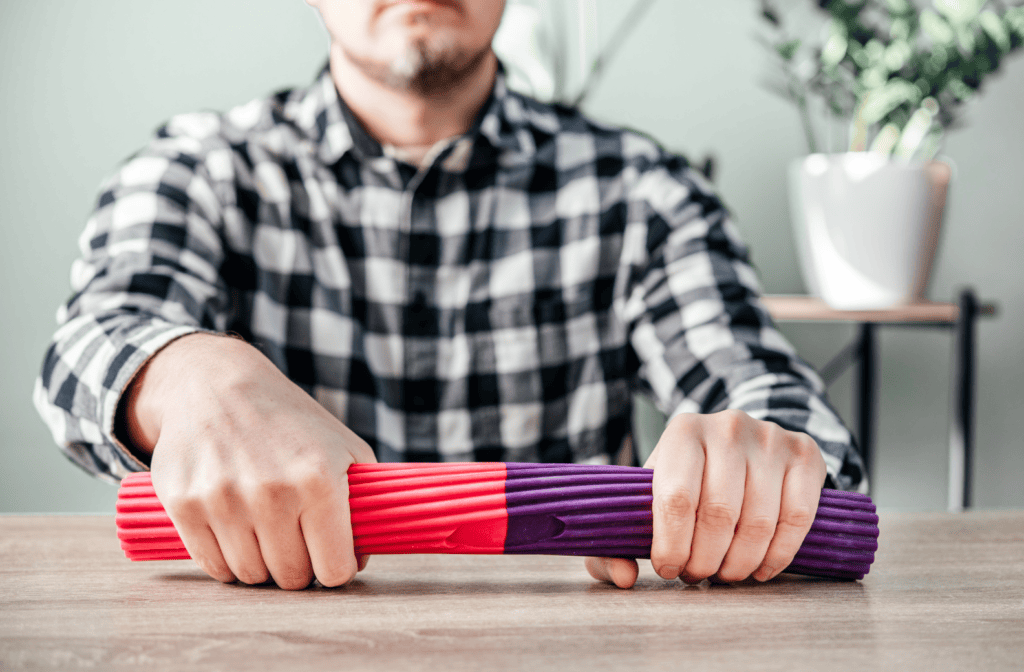
Forearm and grip capacity. Once symptoms are calmer, the hand and forearm need to be strong enough that daily tasks aren’t pushing the tissues past what they can handle.
Progressive grip and forearm strengthening, started below the level that provokes symptoms and built gradually, raises that ceiling. Older reviews were mixed on exercise therapy for carpal tunnel as a standalone treatment, which is one more reason this works best as part of a combined plan.
Shoulder girdle and neck capacity. Since the nerve travels through the neck, shoulder, and arm, rehab usually extends upstream: strengthening the upper back and the muscles that position the shoulder blade, and building tolerance for sustained posture, particularly for people who spend hours at a desk.
This is where a lot of the lifestyle-load factors, like workstation setup and long stretches without movement breaks, get addressed too. Small, modifiable changes here often make a surprisingly large difference.
Where PNF fits. Proprioceptive neuromuscular facilitation techniques are a good match for the tissues around this problem. Contract-relax work for tight forearm flexors, the pecs, and the muscles along the front of the neck can improve range of motion in places that influence how much tension reaches the nerve.
PNF’s diagonal movement patterns for the arm also retrain the shoulder, elbow, and wrist to move together as a single coordinated chain rather than as isolated joints, which better matches how you actually use your hand. It’s not a carpal tunnel-specific treatment backed by its own body of trials. It’s a way of restoring movement quality through the whole arm, which supports everything else in the plan.
Where BFR fits, with some honest caution. Blood flow restriction training can be useful for someone who has lost grip and forearm strength but can’t yet tolerate heavy loading without flaring symptoms, since it allows a real strength stimulus at much lighter loads.
I want to be upfront that this is a reasoned application rather than one with a large body of carpal tunnel-specific research behind it, and there’s an extra consideration: the cuff sits on the upper arm, right along the path of the nerve we’re trying to calm down.
For that reason, it’s something I’d only consider for the right patient, at conservative pressures, with close monitoring of symptoms, and not for anyone whose nerve is acutely irritated. Screening matters here the same as it does for every BFR candidate.
Timeline and expectations. Meaningful improvement from a combined plan typically takes weeks, not days, and the plan should shift as symptoms change: more gliding and positioning early, more strengthening and capacity-building as things settle.
If symptoms aren’t trending in the right direction over a reasonable stretch, or if numbness becomes constant or weakness shows up, that’s when we bring in nerve testing and a hand surgeon. Surgery is a good option for people who need it, and it works well when conservative care has run its course, but for most people with mild to moderate symptoms, there’s a lot worth trying first.
The big takeaway is the same one that runs through almost every condition we treat. Carpal tunnel isn’t one thing, and it isn’t fixed by one thing. It’s the nerve, the tunnel, the tissue around it, the joints above and below it, and the demands of your daily life, all adding up.
The good news is that means there are several places to intervene. Pick two or three that matter most for you, change them, and watch whether your hand follows. A good carpal tunnel treatment plan starts by identifying which of those factors are actually contributing to your symptoms.
Tired of Waking Up With Numb, Tingling Hands?
If your hands are waking you up at night, your grip isn’t what it used to be, or everyday activities are becoming uncomfortable, it’s worth figuring out what’s actually causing those symptoms.
At Redbird Wellness, we look beyond the wrist to understand the factors contributing to your discomfort. Our approach combines hands-on treatment, individualized rehabilitation, and practical changes that fit your everyday life.
Schedule a consultation at Redbird Wellness in Hopkins, MN, and let’s figure out what your hands need to start feeling and functioning better.
