
If you’ve ever searched for dry needling online, or sat through an explanation of it from a clinician, you’ve probably heard some version of this: the needle “releases the knot,” the knot is “full of toxins” or “lactic acid,” and the soreness afterward is those toxins flushing out, so you should drink lots of water to help them along. It’s a tidy story. It’s also wrong, and it’s one of the most common things said about dry needling by the people who do it.
Here’s a test I like. The next time someone tells you a treatment removes toxins, ask which ones. Not “what kind,” but which specific substance, in what amount, leaving the body by what route.
In my experience the answer gets vague very fast. “Toxin” is a word that sounds scientific without being attached to anything measurable, which is exactly why it’s so useful in marketing.
This post is the long version of why dry needling doesn’t remove toxins, where the technique actually came from, and what the research says it’s doing instead. It’s a tool I use regularly in my practice, and I think it’s useful. That’s exactly why I’d rather explain it accurately than lean on a story that doesn’t hold up.
Dry Needling, Deep Dive
What it is
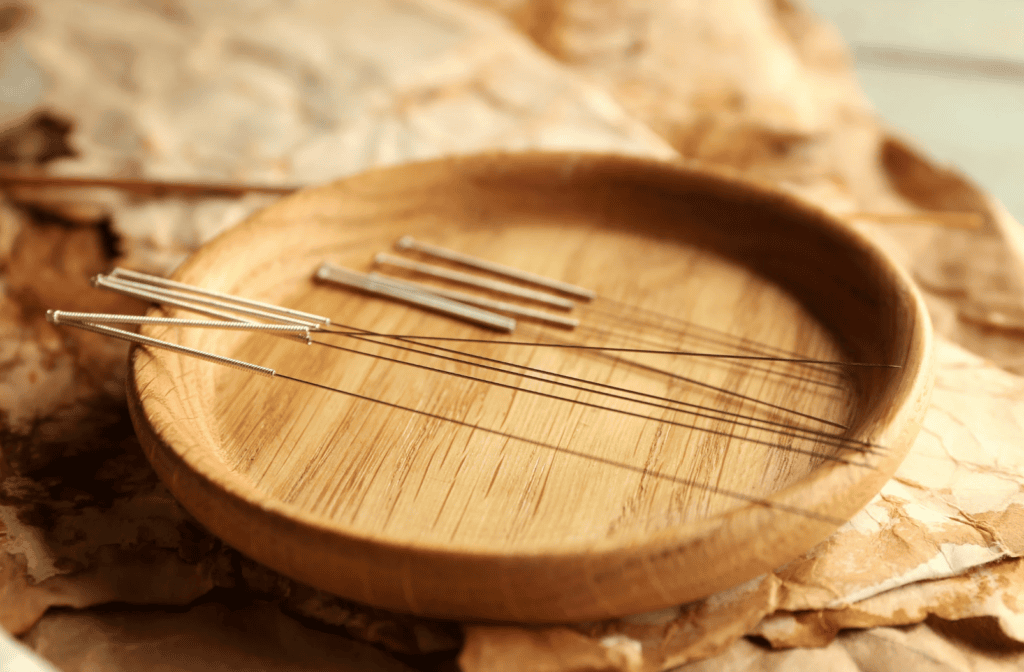
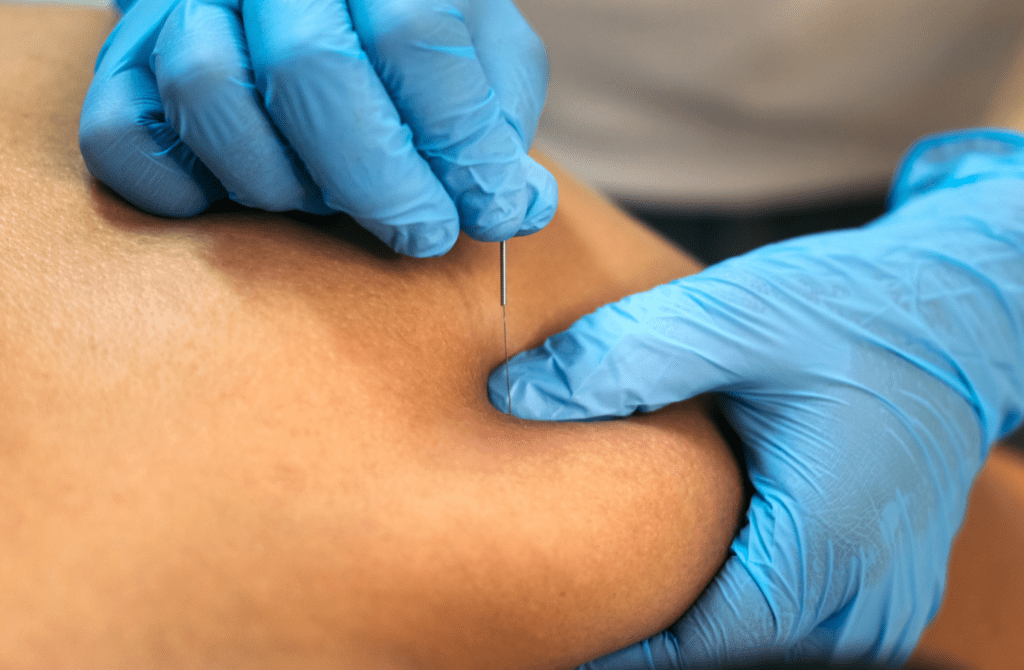
The technique involves the use of a thin, solid needle inserted into muscle or the tissue around it, without injecting any substance. That’s the “dry” part. The needles are the same type of fine filament needles used in acupuncture, and the treatment typically targets tender, tight spots in muscle that clinicians call trigger points, along with the surrounding muscle and connective tissue.
Depending on the approach, a needle might be left in place briefly, moved gently in and out, or angled to reach different spots. Some techniques stay shallow, and others go deeper into the muscle belly.
Many people feel little more than a pinprick on insertion. When a needle contacts a particularly irritable spot, you might feel a deep ache, a cramp-like sensation, or even an involuntary twitch of the muscle.
That’s normal, and a lot of the myths we’ll get to grow out of how people interpret that twitch and the soreness that can follow.
Where it comes from
The history here is more tangled than most explanations let on, and it’s worth telling honestly.
The story begins with Dr. Janet Travell, an American physician who coined the term “trigger point” in the early 1940s to describe hyperirritable spots in muscle that seemed to trigger pain in other areas. She went on to become President Kennedy’s White House physician.
Travell and her colleague Dr. David Simons treated those spots by injecting them with substances like corticosteroids, local anesthetics, and saline. That’s “wet” needling, because something goes through the needle. Years later, in her 1983 trigger point manual, Travell used the phrase “dry needling” to separate a needle with nothing injected from the injection techniques she’d been using. Notably, she preferred a hypodermic needle, not an acupuncture needle, which she considered too thin for the job.
The pivotal moment for the “dry” version came in 1979, when a Czech neurologist named Karel Lewit published a paper called “The Needle Effect in the Relief of Myofascial Pain.” His observation was that the relief people got from these injections didn’t seem to depend on what was injected. The needle itself was producing an effect.
That finding is the foundation of everything that followed: if the needle alone does something, you can skip the drug, and “wet” needling gradually gave way to dry.
A separate thread came from Dr. Chan Gunn, a physician in Canada who in the 1970s began developing what he called intramuscular stimulation, a needling approach built around his theory of nerve-related muscle dysfunction.
Notably, Gunn explicitly set out to connect acupuncture to Western neuroanatomy, proposing in 1976 that acupuncture points be described in terms of the known neural structures beneath them. His teaching program has run continuously since 1994.
So where does acupuncture fit? Honestly, it depends who you ask. Some sources insist dry needling has no historical ties to acupuncture and that the only thing they share is the tool. Others point out that early pioneers like Gunn deliberately drew on acupuncture, that trigger points and acupuncture points show real overlap, and that the needles used today are the same ones.
I think the fairest summary is this: the framework behind dry needling is anatomical and neurophysiological, not built on energy or meridians, but the technique and its tools have enough shared ancestry and overlap that pretending the two have nothing to do with each other isn’t accurate either. Either way, nothing in that history gives anyone a basis for claiming it removes toxins, as we’ll see.
What it’s been used for
Over the last several decades, the technique has spread from a niche technique to a common tool in sports medicine, physical therapy, and chiropractic practice. It’s used mostly for muscle-related pain and tightness: neck and shoulder pain, low back pain, tension-type headaches, and pain around tendons and joints, often alongside exercise rather than instead of it.
Clinicians have studied it as part of plans for conditions like plantar heel pain and after shoulder surgery, and in my own practice I often pair it with manipulation for headaches, using dry needling on tight neck and shoulder muscles and manipulation on stiff joints.
It’s worth being upfront about the state of the research. Reviews of the literature have found less high-quality evidence for needling directly into trigger points than many practitioners assume, and they’ve also found that trigger points themselves are hard to identify reliably: different clinicians palpating the same muscle often don’t agree on where they are, and there’s no widely validated set of diagnostic criteria.
That doesn’t mean the technique doesn’t help people, since the outcomes data in many studies are encouraging. It means the original explanation, a discrete “knot” that gets “released,” is a simplified working model, not a settled fact.
It’s a good example of something I’ve said before about manual therapies generally: the outcomes and the explanation for those outcomes are two different questions, and they don’t always rise or fall together.
Mythbusting
Myth #1: Dry needling releases toxins from your muscles
This is the headline claim, and it shows up everywhere. Some clinics state it outright, telling patients that needling releases “toxins” into the muscle that need to be flushed out afterward. Others hedge with language like “dry needling isn’t a detox method, but it can support your body’s natural detox processes by promoting circulation.”
Both versions lean on the same shaky idea: that muscle tension traps harmful waste, and that a needle lets it out.
Here’s the problem. “Toxins” isn’t a defined physiological substance, so there’s nothing for the claim to be tested against. Your body already has well-understood waste-removal systems, mainly the liver, kidneys, lungs, and the lymphatic and circulatory systems, and none of them are waiting on a needle to open a drain.
A needle puncture is a tiny wound, not an exit route. Increasing blood flow to a muscle is a real and documented effect of needling, but better blood flow to a small area isn’t the same thing as detoxifying anything. If the explanation requires a toxin that can’t be named, measured, or shown to leave the body, it isn’t an explanation. It’s marketing language.
Myth #2: It releases lactic acid from the knot
This is the more scientific-sounding cousin of the toxin myth, and it’s even been stated in clinic handouts: that releasing a trigger point releases lactic acid into the muscle, and that’s what makes you sore. It’s a claim that sounds technical enough that people rarely question it.
But lactate doesn’t work that way. Lactate is a normal fuel your muscles produce and reuse, and it clears from your blood within roughly 30 to 60 minutes after intense exercise. Researchers have measured this directly, and when they did, they found that the timeline of blood lactate has nothing to do with the timeline of soreness.
In one classic experiment, volunteers were sorest after downhill running, which was when their lactate levels were lowest. Even at the height of an intense workout, lactate itself isn’t what causes the burn, and by the time delayed muscle soreness shows up one to three days later, there’s no lactate left to blame.
If lactic acid doesn’t cause the soreness after a hard workout, it’s hard to argue a needle is releasing a stored reservoir of it from a spot in your shoulder.
Myth #3: The soreness afterward means toxins are flushing out, so drink water to help them along
This one rides along with the first two. The idea is that post-needling soreness proves something was released, and that hydration and movement will flush it. Some clinics even build it into their aftercare instructions.
Soreness after needling is real and common. Plenty of people feel a dull ache in the treated area for a day or two, similar to how you might feel after a hard workout.
What I think is going on is a local tissue response to the needle itself, the same general territory as the soreness you feel after exercise, which is linked to mechanical stress and microscopic muscle fiber damage and the repair process that follows. That’s a working explanation, not a proven one.
What it isn’t is evidence that anything toxic left your body. Staying hydrated and staying moderately active after a session is good advice for lots of reasons, including how your muscles recover, but it’s not flushing anything out. The soreness is a response to the treatment, not a signal that waste is leaving.
Myth #4: The twitch means you got the knot, and the needle physically breaks it up
There’s a version of the toxin story that depends on a physical picture: a knotted bundle of tissue that the needle pops open, with the twitch as proof it worked. It’s an appealing image, and it’s built into how a lot of dry needling is taught.
The research doesn’t back it up as neatly as the image suggests. Systematic reviews have found that the local twitch response doesn’t reliably predict how well someone does, and some meta-analyses suggest it affects short-term pain more than longer-term function. Needling without chasing a twitch has support too.
And as noted above, the “knot” itself isn’t something clinicians reliably agree on when they find it by touch. If the twitch were a sign of a physical blockage being cleared, you’d expect it to track with outcomes more consistently than it does.
So I’d rather not tell you a needle snapped something loose. I’d rather say that a twitch can happen, it can feel dramatic, and it isn’t the thing that determines whether the treatment helped.
Myth #5: If it’s not removing toxins, it must just be placebo
This is the opposite error, and I hear it from skeptics who are, in fairness, reacting to exactly the kind of overclaiming above. If the explanation is wrong, they reason, the treatment must be empty.
That doesn’t follow. A wrong explanation and a real effect can coexist. Research on dry needling has found real, measurable changes.
In animal studies, needling at trigger spots changed local levels of chemicals tied to pain, inflammation, and low oxygen, including substance P and TNF-alpha, and some of the effects showed up at the spinal cord level and in muscles at a distance from the treated site.
Those are chemicals that sensitize pain pathways, not toxins, and the findings suggest the nervous system is being influenced at multiple levels. Human studies have found that needling can increase blood flow and oxygenation in a treated muscle, and that it can trigger pain-dampening effects at the spinal cord segment connected to that muscle.
How much of the benefit people feel comes from each of those effects is still being worked out.
What It Actually Does Instead
I want to be careful here, because I’ve just spent a couple thousand words telling you why a popular explanation is wrong, and it would be hypocritical to replace it with a different one I can’t fully back up. So here’s the honest version.
Dry needling appears to work primarily through the nervous system, with some contribution from local changes in the muscle. It likely increases blood flow in the area, it appears to alter local pain-related chemistry, and it triggers pain-modulating responses in the spinal cord and brain, similar in kind to the effects we see from other manual therapies.
Evidence for the benefits comes mainly from short-term pain relief and improved movement, and it tends to work best when it’s paired with exercise and movement rather than used alone.
The simple trigger point “knot” model is a useful way to explain where to needle and what you might feel, but it’s a simplified picture, not a proven anatomical fact, and I try to treat it that way.
What I’m confident in is this: dry needling is a legitimate tool with plausible, measurable effects, and “removing toxins” isn’t among them. If a clinician tells you otherwise, it’s fair to ask which toxins, how they leave the body, and what the evidence is.
A good answer exists for the questions worth asking about dry needling: What is it helping? How will we know it’s working? What else are we doing alongside it?
Those are better questions than whether something got flushed out, and they’re the ones I try to answer for every patient who sits down in my office.
Curious Whether Dry Needling Could Help You?
Dry needling doesn’t need a detox story to be a useful part of treatment. What matters is understanding your symptoms, choosing an appropriate approach, and making sure the care you’re receiving is actually helping you move and feel better.
At Redbird Wellness, we use dry needling alongside other evidence-informed treatments when it’s appropriate for your needs, rather than treating it as a standalone solution.
Schedule a consultation at Redbird Wellness in Hopkins, MN, to discuss your symptoms and whether dry needling could be part of your treatment plan.
